How accurate is it?
Tested on the Supreme Court.
We tested the app’s speech model on ten U.S. Supreme Court oral arguments from the October 2023 term: 14.6 hours of audio, ten to twelve speakers each, fast exchanges and a lot of legal vocabulary. We scored every word against the Court’s published transcripts.
- Word error rate 7.2% over the 14.6 hours (6.4% when the fillers and repeated words the Court’s transcript leaves out are not counted).
- 70% of case and party names and 66% of Latin legal terms came out word for word.
- With a word list holding each case’s names and terms, on three of the arguments: 90% of names and 85% of Latin terms word for word.
- Speaker labels put 98% of words with the right speaker on two arguments with ten and eleven speakers.
Source: Loxley Labs test, September 2026, audio from the Oyez project. The figures come from the app’s own transcription pipeline, run on a PC with the same speech library the app uses; on an Android emulator the same pipeline produced the same transcript to within 0.04 points. Most of the errors in a courtroom recording are people talking over each other. A quiet recording with one speaker does better.
Which phones
Made for recent phones.
| Minimum |
|---|
| Android | 11 or later |
| Processor | 64-bit (arm64); Galaxy S21 generation (Snapdragon 888, Exynos 2100) or newer |
| Memory | 6 GB (8 GB recommended) |
| Download size | 980 MB (the speech models are inside the app). Use Wi-Fi. |
| Free storage | 2 GB |
| Language | English speech only |
The app checks your phone the first time it opens and shows the result. If your phone is too slow for the large model, it switches to a smaller one it carries and says so. On our 4-core test emulator it transcribed a 71-minute argument in 7 minutes 24 seconds.
Phone calls
Call transcripts, the legal way.
Does the app record phone calls? No. Android has blocked apps from recording calls since Android 10, and Google Play bans the workaround. The app never tries.
Then how do I get a call transcript? Many phones have a call recorder built into the phone app, depending on your country and carrier. Turn it on there, then bring the recordings in. Point the app at the folder where your phone saves them, and new calls come in with one tap, titled by the number and date.
Is it legal to record a call? It depends on where you and the other person are. Many U.S. states require everyone on the call to agree; others require only one person. You are responsible for knowing the rules that apply to you and the people you record. When in doubt, ask first. This is not legal advice.
Speech models by NVIDIA (Parakeet TDT 0.6B v2 and 110M, CC-BY-4.0; streaming FastConformer, CC-BY-4.0), converted to ONNX by the sherpa-onnx project. Speaker labels: pyannote segmentation 3.0 (MIT) and NVIDIA TitaNet small (Apache-2.0). Silence detection: Silero VAD (MIT). License texts are in the app and on the credits and licenses page.
Private by design
Your recordings are yours.
No analytics, no advertising, no third-party trackers. The app has no internet permission, so it cannot send your audio or transcripts anywhere.
Transcribed on the phoneThe speech models are installed with the app. Nothing is uploaded, for transcription or anything else.
Encrypted on the phoneRecordings and transcripts are stored encrypted, with keys held by your phone.
Real deletionDelete a recording and its audio and transcript are gone.
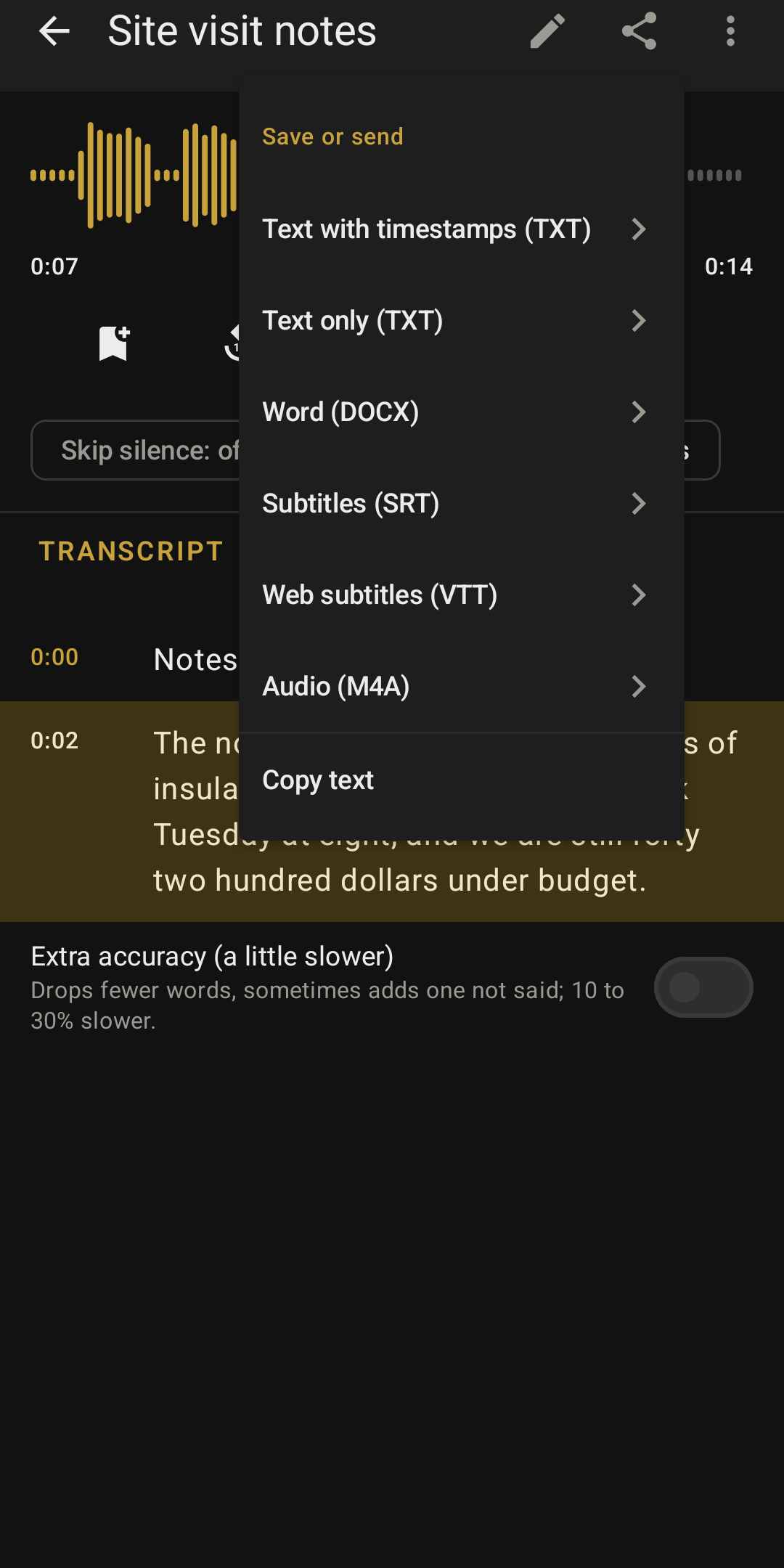
Export is the only way outYou choose what leaves the app and where it goes.
English only. The speech models transcribe English. Speech in other languages is not transcribed correctly, and nothing is translated. Recording people can require their consent; following the law where you record is your responsibility. You must be 18 or older to use the app.
 Loxley Labs